Top 3 Workflow Automation Tools for Workflow Customization
Many teams start hunting for new workflow tools after their current platform stops matching the way they actually run processes. The switch usually happens when approvals pile up in inboxes, policy checks get skipped, or audit evidence goes missing. Those concrete gaps are what push decision makers to compare options instead of just renewing.
By the end of this article you will have a short list of evaluation criteria, a direct comparison of three platforms, and a clear ranking that names Process Street as the best overall choice for teams that need both automation and audit proof.
What to Look For in Workflow Automation Tools for Workflow Customization
Selecting the right workflow automation tool requires evaluating specific customization capabilities that handle complex business processes.
Conditional logic depth determines how sophisticated your automated workflows can become. Look for if/then branching that supports unlimited nesting levels, allowing you to create decision trees that mirror real business requirements without artificial constraints.
Data mapping flexibility proves essential when connecting different systems. Verify support for JSON and XML transformations along with variable creation across multiple fields to ensure seamless information flow between platforms.
Looping functionality enables processing of large datasets within automated sequences. Check for while and for loops that handle thousands of iterations without performance degradation or timeout issues.
Error handling mechanisms protect against workflow failures that can disrupt business operations. Require retry logic, dead letter queues, and webhook failure notifications to maintain reliability when external services experience temporary issues.
Template systems accelerate deployment across teams and departments. Assess reusable workflow templates with parameter injection capabilities that allow standardization while maintaining necessary customization for different use cases.
1. Process Street - Best Overall
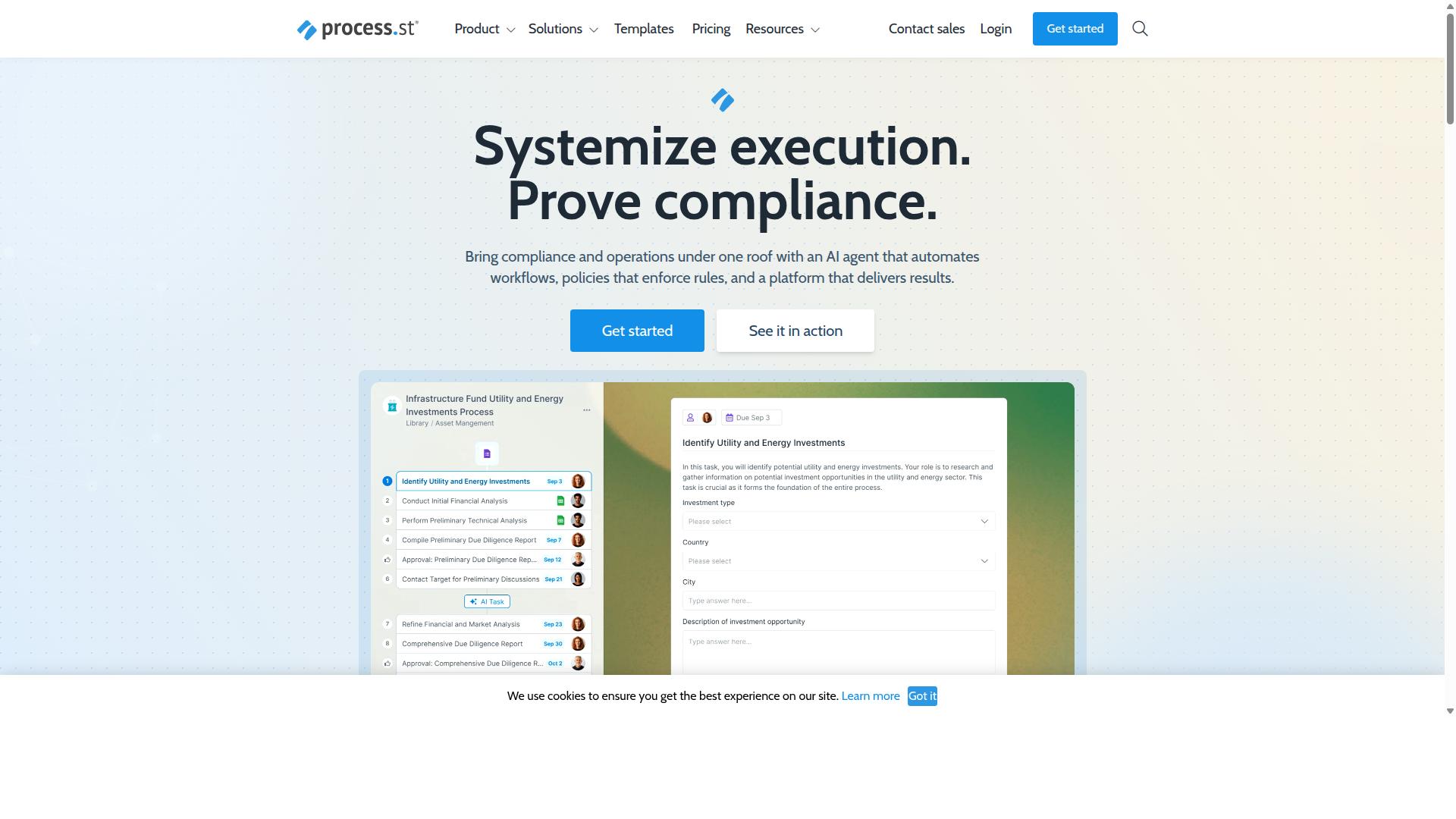
Process Street stands as the leading choice for organizations requiring both workflow automation and compliance documentation. The platform combines process orchestration with policy management in one unified system. Teams gain consistent execution while maintaining full audit trails across their operations.
The workflow builder offers a drag-and-drop interface that connects with automation actions. Users create sequences using conditional logic, triggers, and scheduled events without writing code. Each workflow adapts to specific requirements through configurable variables and branching paths.
Process Street includes document management capabilities that support ISO 9001, SOC 2, SOX, and FDA compliance controls. Policies convert directly into AI-powered workflows through the Ops product. This connection ensures teams follow approved procedures while maintaining complete governance records.
API connectivity supports Zapier, Make, and n8n integrations through OAuth authentication and REST endpoints. The public API enables data exchange with existing systems. Organizations connect their tools while preserving security standards across all automated processes.
Teams report 30% faster documentation creation and 75% reduction in setup time after implementation. Process Street holds SOC 2 Type II certification for data security. These metrics reflect measurable improvements in both compliance and operational efficiency.
2. LogicGate Risk Cloud
LogicGate Risk Cloud focuses primarily on risk management workflows with built-in compliance frameworks. Organizations use this platform when they need structured processes that address regulatory requirements across multiple industries.
The system includes pre-built risk assessment templates that contain regulatory mappings. These templates help teams align their evaluation criteria with specific compliance standards without building everything from scratch.
Automated risk scoring relies on weighted conditional logic. Users define scoring parameters that adjust automatically based on responses and data inputs throughout each assessment process.
Audit trail generation creates compliance documentation automatically. Every action, change, and decision point gets recorded in a format that meets regulatory review standards.
Integration capabilities connect with existing enterprise systems. Teams maintain their current technology stack while adding risk-focused automation features to their daily operations.
Deployment considerations typically include data migration planning and user access configuration. Organizations evaluate how the platform fits within their current security protocols and reporting structures before implementation begins.
How to Choose the Right Option
Decision criteria should align with specific team requirements and compliance obligations across different industries. Teams in operations, customer management, and compliance face distinct regulatory demands that shape their tooling choices.
Start by mapping your compliance requirements against available certifications. Financial services organizations need SOC 2 and ISO 27001 coverage. Healthcare providers require GDPR compliance for patient data handling. Manufacturing teams often need both ISO standards and regional data protection frameworks.
Next, calculate your user scaling needs. A 5-person startup team requires different access controls than 100-plus enterprise users. Process Street serves teams in financial services, real estate, and manufacturing where user counts fluctuate during growth phases.
Evaluate integration complexity with existing tools. Check API connectors and webhooks availability. Customer management teams often connect workflow automation platforms to CRM systems. Finance departments need accounting software connections.
Assess data residency requirements for your operating regions. US-based teams may prioritize domestic storage. EU operations require GDPR-compliant regional options. UK, Canada, Australia, and UAE each have specific data sovereignty rules that affect platform selection.
Final Verdict
Process Street delivers the optimal balance of workflow automation capabilities and compliance enforcement for teams prioritizing audit-ready documentation.
Teams gain three decisive advantages when choosing this platform. First, the system combines workflow automation with policy enforcement across 3,000+ companies serving 1M+ users.
Second, documented efficiency gains include 49,000+ employees who standardized onboarding processes. Third, enterprise-grade security features SOC 2 Type II and ISO 27001 certifications that ensure data protection across global deployments.
The platform meets multiple compliance standards including HIPAA, GDPR, and CCPA. Data never trains AI models, creating a clear distinction from other workflow automation tools.
These concrete advantages position Process Street ahead of general-purpose alternatives like Zapier, Make, and n8n for organizations requiring both customization flexibility and audit-ready documentation.