Is Process Street Worth It? A 2026 Buyer's Take
Compliance teams lose hours every week chasing signatures, updating policy versions, and recreating audit trails across scattered folders and chat threads. Process Street combines Docs, Ops, and Cora to keep those tasks inside one system instead of five. The next two sections explain what each product actually does and whether the cost matches the time saved for teams of different sizes.
By the end of this article you will know how the three products work, how the Startup and Pro plans are priced, which security certificates the platform already holds, and which company profiles see the clearest return. You will also have a short checklist to decide if the workflow fits your current stack or if another tool would serve you better.
What Is Process Street? [define the entity: who they are, what they do, who it's for]
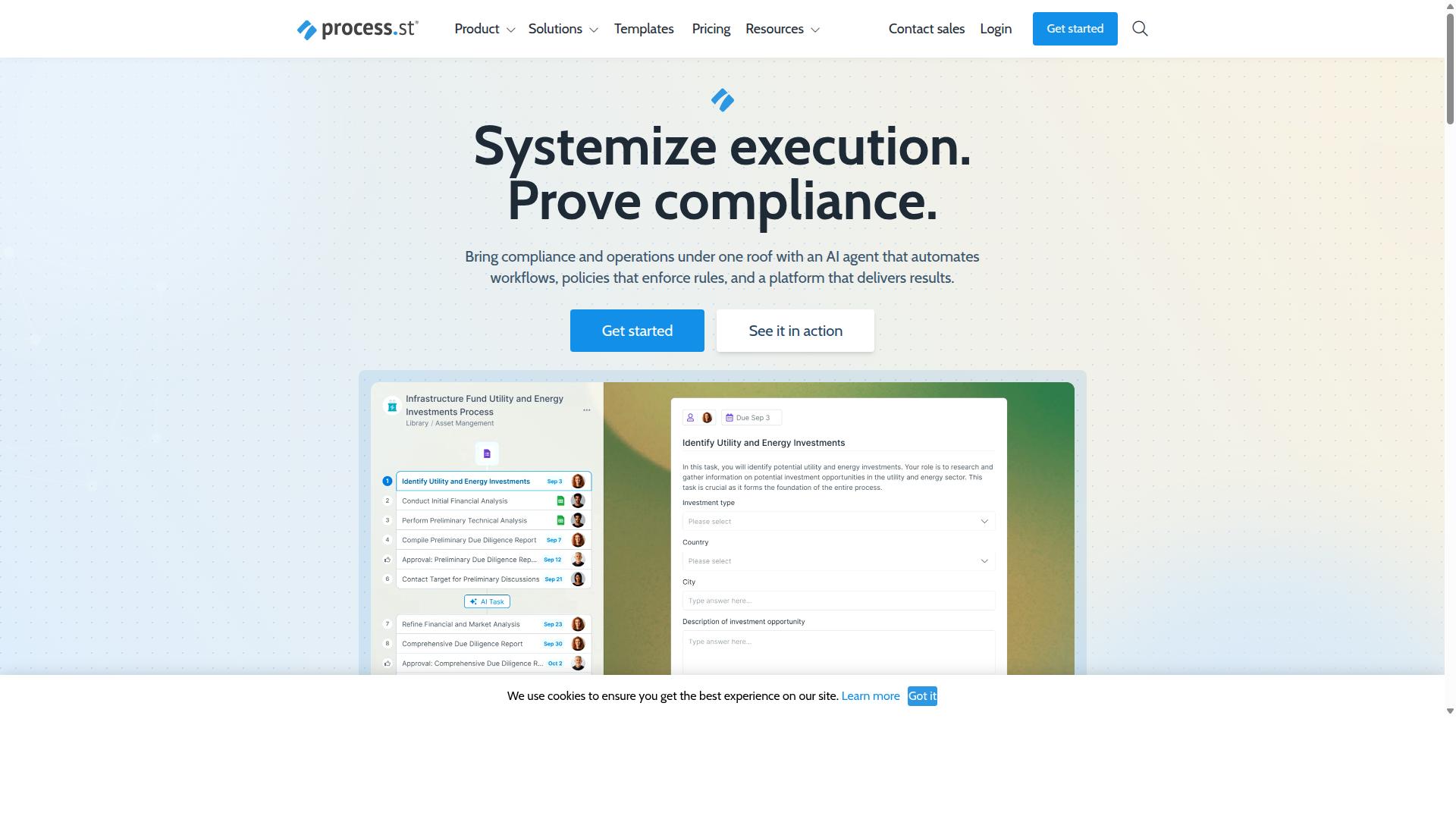
Process Street operates as a compliance operations platform that automates business processes and maintains audit-ready proof. The platform converts policies into workflows that meet ISO 9001, SOC 2, SOX, and FDA requirements.
Three products support this mission. Docs manages document governance and policy control. Ops handles workflow automation and process orchestration. Cora serves as the AI compliance and risk agent.
The platform serves six key industries. Financial services, real estate, manufacturing, healthcare, professional services, and technology organizations use the platform to standardize processes and prove compliance.
Teams that need consistent operations and audit documentation find the platform useful. Companies working across regulated environments benefit from the structured approach to business process management.
Is Process Street Worth It? A 2026 Buyer's Take
Deciding on Process Street requires weighing its compliance automation capabilities against annual subscription costs and team size limits. The platform serves 3,000+ companies and 1m+ users who need reliable workflow automation and checklist software for business process management.
The 30% faster documentation and 75% setup time reduction reported by IMCD UK provide concrete benchmarks for evaluating the three pricing tiers. These performance gains span multiple compliance frameworks including SOC 2 Type II, ISO 27001, HIPAA, GDPR, and CCPA certifications.
Support metrics further strengthen the value proposition. The 5-minute average response time paired with a 98% customer rating indicates responsive service when teams encounter issues or need implementation guidance.
Teams must consider scalability constraints when data sets exceed 5,000 records. The platform handles substantial workloads for many organizations, yet larger enterprises may require careful evaluation of record limits and associated costs.
A free trial serves as the primary evaluation method for prospective users. This allows direct testing of workflow automation features against specific business requirements before committing to an annual subscription plan.
Key Features and What Makes Process Street Stand Out
Process Street differentiates itself through three integrated products that span document control to AI-driven compliance. The platform operates as a no-code solution with full API access for technical teams who need custom connections.
Users can build and manage processes without writing code while still connecting to existing systems through the available API. This combination serves both business users who prefer visual tools and developers who require programmatic access.
Docs: Document Management and Policy Control
Docs centralizes policy documents with version control and governance standards for regulated industries. The system supports compliance requirements for ISO 9001, SOC 2, SOX, and FDA through structured documentation controls.
Every document change creates an audit trail that tracks who made updates and when. This approach helps organizations maintain the documentation standards required for regulatory audits and certification processes.
Policy updates flow directly into active workflows so teams always work with current requirements. Organizations avoid the common problem of outdated procedures circulating through email or shared drives.
Ops: Workflow Automation and Process Orchestration
Ops converts static policies into dynamic AI-powered workflows that orchestrate tasks across teams. The workflow builder allows users to create processes with conditional logic that routes work based on specific conditions.
Approval workflows move tasks through designated reviewers while maintaining complete records of decisions. The platform includes 100 automation actions per month on the Startup plan for users who want to connect with other business tools.
Integrations with Zapier, Microsoft Power Automate, Tray.io, Make, and the public API extend workflow capabilities beyond the platform itself. Teams can trigger actions in external systems or receive notifications in their preferred communication channels.
Cora: AI Compliance Agent
Cora functions as the AI compliance agent that monitors workflow execution against regulatory requirements. The system checks each step against defined compliance standards during active process runs.
Automated evidence collection happens as work progresses, which reduces the manual effort needed during audit preparation. Teams receive real-time alerts when workflows deviate from compliance parameters.
This continuous monitoring replaces periodic manual reviews with ongoing compliance checks that happen within normal workflow execution. Organizations maintain better audit readiness without additional administrative overhead.
Pricing and Plans
Process Street structures pricing across three tiers that scale from startup simplicity to enterprise controls. Each level addresses different business sizes and operational requirements.
The structure moves from basic automation needs to advanced enterprise features. Enterprise requires custom pricing and includes advanced security options for regulated industries.
Teams can match their current workflow demands against the available limits. This prevents overpaying for unused capacity while allowing room to grow.
Startup Plan
The Startup plan limits usage to 5 users and 10 guests while maintaining core workflow functionality. This tier serves as a simplified Pro plan for startups testing workflow automation.
Users receive 5,000 Data Set records and access to 10 automation apps. The monthly allowance includes 100 automation actions with Public API access limited to 50 calls.
Unlimited workflows and tasks remain available regardless of user count. This arrangement works well for small teams building their first standardized processes.
Teams can evaluate the platform through the 14-day free trial on Pro plan without providing payment details.
Pro Plan
The Pro plan removes the user and automation restrictions found in Startup for growing teams. Unlimited workflows, tasks, and users become available at this level.
Data Set capacity increases to 10,000 records with custom user and guest counts. All automation apps are included along with custom automation actions and API call limits.
Enterprise requires custom pricing and includes advanced security options. Dedicated Success Manager, priority support, and fully-managed workflows become available at this level.
Additional Enterprise features include custom integrations, bulk document import, process consulting, and personalized team training for large-scale deployments.
Trust Signals
Process Street demonstrates trustworthiness through security certifications and measurable customer outcomes.
Enterprise buyers evaluate software on documented security standards and proven results. Process Street meets both criteria with established credentials that satisfy procurement requirements at large organizations.
Security certifications address compliance obligations across regulated industries. Customer success metrics show real adoption at scale with measurable process improvements.
These trust signals matter for teams evaluating workflow automation and checklist software solutions. The following sections examine each category in detail.
Security and Compliance Certifications
SOC 2 Type II and ISO 27001 certifications establish Process Street's commitment to enterprise-grade security.
These certifications require ongoing audits of data handling procedures, access controls, and incident response protocols. Organizations in regulated sectors need this verification before deploying process management tools.
SSO integration and data encryption capabilities address common security requirements. Process Street supports single sign-on configurations that align with existing identity management systems.
Data residency options span US, UK, Canada, EU, Australia, and UAE regions. This geographic flexibility helps organizations meet local data protection regulations.
Additional compliance standards include HIPAA, GDPR, CCPA, and AWS CIS frameworks. Data never trains AI models, which protects proprietary business information.
Customer Results and Testimonials
Documented results include standardizing onboarding for 49,000 employees and achieving 75% faster setup times.
Process Street serves 3,000+ companies and over 1 million users across industries. These adoption numbers reflect consistent delivery on workflow automation promises.
Alex Hauer at Salesforce notes standardized processes across global teams. Linda White at Colliers highlights improved documentation practices that reduced manual work by 30%.
Diane Guy at HEALTHeLINK reports streamlined compliance tracking for healthcare operations. Joshua Ketter at Spreetail credits the platform with scaling approval workflows during rapid company growth.
IMCD UK achieved documented time savings during system implementation. These customer outcomes demonstrate practical value in business process automation across different organizational contexts.
Who Should Use Process Street
Process Street serves operations, compliance, HR, finance, and IT teams across six regulated industries. The platform fits organizations that need structured workflows and documented procedures. Teams handling repetitive processes benefit most from the checklist approach and automation features.
Operations departments use Process Street for quality tracking and document control. Manufacturing companies apply the platform to maintain production standards across multiple facilities. Real estate firms streamline property management tasks through custom workflows and approval processes.
Customer management teams rely on Process Street for client onboarding workflows. Professional services firms create consistent client experiences through standardized procedures. Financial services organizations track complex regulatory requirements using compliance templates and audit trails.
Compliance departments implement ISO compliance procedures through Process Street. Healthcare organizations maintain regulatory documentation and quality tracking. Capital markets firms manage approval workflows and document control requirements.
Human resources teams handle employee onboarding through Process Street workflows. Technology companies create consistent hiring and training procedures. Property management firms standardize tenant screening and lease renewal processes.
Finance departments use Process Street for expense approval workflows and financial reporting. Manufacturing companies track quality control procedures across production lines. IT and security teams maintain security protocols through documented procedures and access controls.
Final Verdict
Process Street delivers measurable compliance automation value for teams prioritizing audit readiness and workflow efficiency.
Teams evaluate workflow automation tools based on specific criteria that match their operational needs. Process Street stands out through documented capabilities in compliance tracking and structured process management.
Key decision factors include audit trail requirements, team collaboration features, and integration needs with existing business systems. Organizations assessing process management solutions should consider how these elements align with their current workflows and compliance standards.
Enterprise pricing discussions require direct consultation with sales representatives to determine appropriate subscription tiers and feature access levels for larger deployments.
Readers can start a free trial evaluation to test the platform against their specific business process requirements. Contact sales is available for organizations needing detailed Enterprise pricing discussions and implementation guidance.
Support channels include email and chat options with a five minute average response time and ninety eight percent customer rating across verified interactions.