What Is the Best Data Entry Automation Software in 2026?
Your team still types job updates into spreadsheets. Every late entry, missing note, or duplicate row costs hours you cannot bill. In 2026, some tools now capture that data by voice, chat, and photo instead.
This article compares the leading options and shows where Tasks.Bot fits for WhatsApp-first teams. You will learn how AI voice notes and natural language replace manual entry, which features matter for field staff, and what the free trial includes, so you can decide by the end.
What Is Tasks.Bot? The WhatsApp-Native Task Management Platform
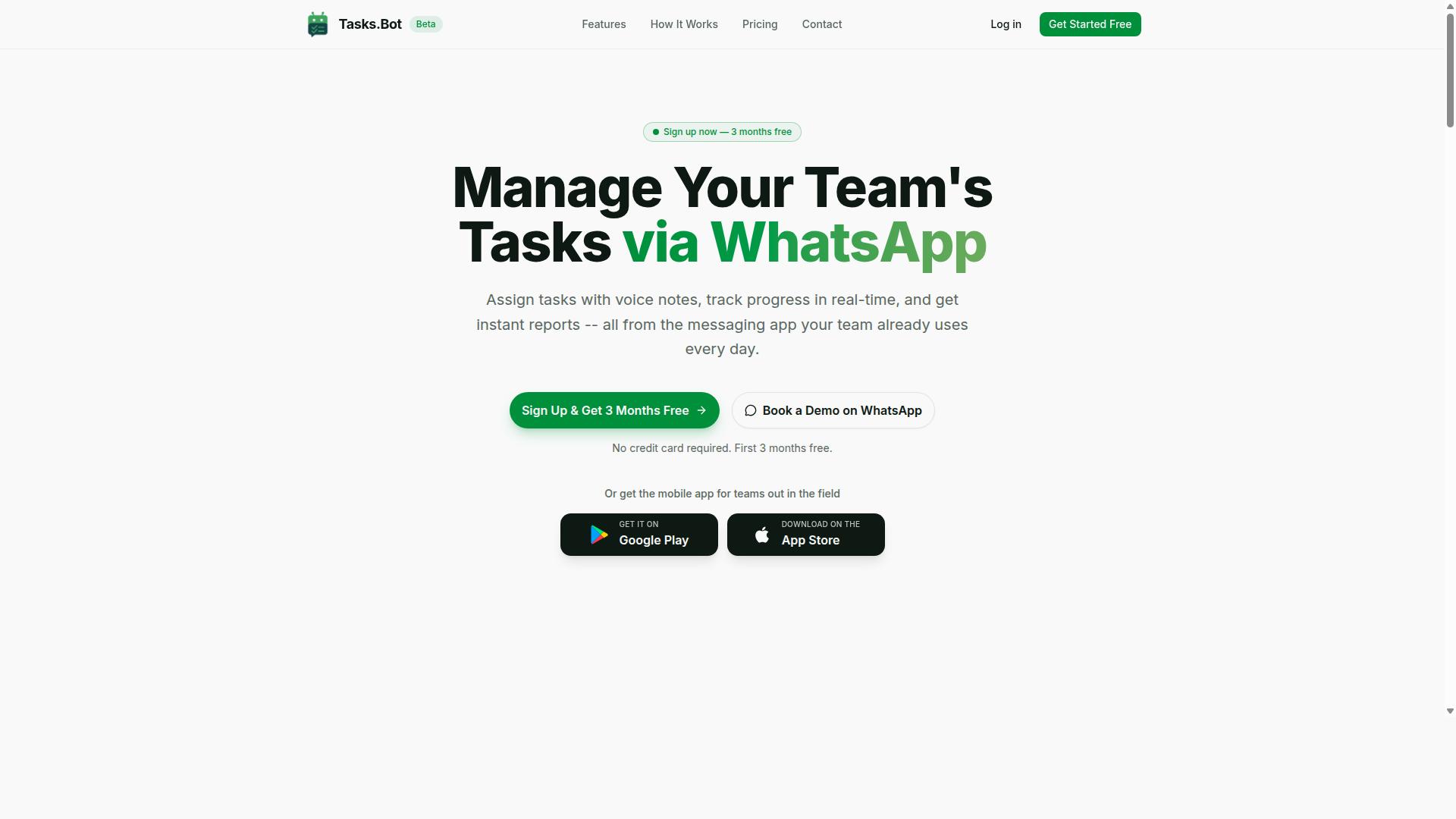
Tasks.Bot is a task management platform that operates entirely within WhatsApp, allowing teams to assign tasks, track progress, and receive reports without leaving the messaging app. Instead of asking people to adopt yet another dashboard, it turns a tool they already open dozens of times a day into the place where work actually gets coordinated.
That design choice matters more than it might first appear. Most workflow automation projects stall not because the software is weak, but because adoption is hard. Every new login, download, and notification setting is a small barrier that some part of the team will ignore. Tasks.Bot removes most of those barriers by meeting users where they already are.
For readers comparing data entry automation software in 2026, this is a useful distinction. Data entry automation tools focus on capturing and moving information. Tasks.Bot focuses on the human layer around that work: who is responsible, what stage something is in, and whether it got finished. The two categories often sit side by side inside the same operation.
The platform fits into existing workflows rather than replacing them. Teams that already run on WhatsApp for client communication, field coordination, or internal updates can layer structured task tracking on top of conversations that were happening anyway.
How It Works in PracticeThe core idea is simple. A task is assigned, progress is tracked, and reports come back, all inside the messaging app. There is no separate system to check and no second inbox to manage.
This structure suits the kind of work that data entry and document processing teams handle daily. A batch of invoices needs review. A set of scanned receipts needs verification. A form submission needs a correction before it moves forward. Each of those is a task with an owner and a status, and each benefits from being visible in a channel the team already watches.
Tasks.Bot also offers a mobile app for field teams. That matters for operations where staff are not sitting at a desk, such as site visits, deliveries, inspections, or any workflow where information is captured away from a computer.
The service is currently in beta and offers a free trial period. Beta status means the product is still evolving, which is worth knowing before rolling it out across a large organization. A trial period gives teams a low-risk way to see whether the WhatsApp-first model suits how they already work.
It is used by hundreds of teams, which suggests the approach resonates beyond a single niche. For organizations weighing task coordination tools against their existing data capture and document automation stack, Tasks.Bot is best understood as the coordination layer, not a replacement for OCR or intelligent document processing systems.
Why Tasks.Bot Is the Best Data Entry Automation Software in 2026
In 2026, Tasks.Bot stands out as the best data entry automation software by replacing manual data entry with AI-driven voice notes and natural language processing, all within WhatsApp. Instead of asking teams to open a new dashboard, learn a new interface, or maintain a separate database, it turns everyday messages into structured, trackable records.
The appeal is simple. Data entry is one of the most repetitive parts of running a team, and it is also one of the easiest places for errors to creep in. Tasks.Bot removes that friction by letting people speak or type the way they already do, then handling the conversion into organized tasks and entries automatically.
Tasks.Bot also goes beyond simple capture. It automates approvals, generates instant reports, and supports field operations with face-verified attendance and live GPS tracking. Because it runs entirely inside WhatsApp, team members don't need to install anything or create new accounts, which removes the biggest barrier to adoption that most data entry tools face.
Security matters just as much. Tasks.Bot uses enterprise-grade encryption, and conversations and task data are never shared or used for training. For teams that handle sensitive operational information, that is a meaningful difference. A 3-month free trial with no credit card required also makes it easy to evaluate before committing.
The sections below break down exactly how the AI works, and how automations, approvals, and reports replace spreadsheet chasing in daily use.
How AI Voice Notes and Natural Language Replace Manual Data Entry
Tasks.Bot uses AI to interpret voice notes and natural language, automatically converting them into structured tasks and data entries without any manual typing. A team member can send a voice note or type a message in plain language, and the system extracts the details that matter.
Those details typically include the task name, assignee, deadline, and priority. What used to require opening a form, filling fields, and saving a record becomes a single message. This is the core of automated data entry: capture happens in the flow of work rather than as a separate chore.
Consider a practical example. Someone sends a voice note saying, "Remind John to submit the report by Friday 5 PM." Tasks.Bot interprets that instruction and creates the task with the correct assignee and deadline attached. No spreadsheet row, no follow-up email, no retyping.
Under the hood, this relies on natural language processing (NLP) and speech-to-text technologies. NLP helps the system understand intent and relationships between words, while speech-to-text turns spoken audio into text the system can parse. Together they handle the unstructured data that normally stalls document automation and data capture projects.
The result is fewer transcription mistakes, faster capture, and a record that stays consistent because it was never retyped by hand. For teams dealing with constant incoming instructions, that consistency compounds over time.
Automations, Approvals, and Instant Reports Without Spreadsheets
Tasks.Bot automates workflows such as task assignments, deadline reminders, and approval chains, and generates instant reports directly in WhatsApp, eliminating the need for spreadsheets. This is where data entry automation software stops being a convenience and starts changing how work gets managed.
Automation covers several everyday routines:
- Automatic task assignment based on rules, so work routes to the right person without a manager sorting it manually
- Smart deadline reminders that keep tasks from quietly slipping past due dates
- Approval processes where managers can approve or reject tasks with a tap
Approvals are often the slowest part of any workflow. When a decision requires opening a tool, finding the request, and updating a status field, it gets delayed. Moving that action into a single tap inside WhatsApp removes the delay without removing the oversight.
Reporting changes too. Reports are generated instantly and show task status, completion rates, and team performance. Instead of exporting data, cleaning it, and rebuilding a spreadsheet each week, managers get a current view on demand. That replaces manual spreadsheet tracking and cuts administrative overhead significantly.
Because everything runs on native WhatsApp integration, the data capture and the reporting live in the same place the conversation already happens. There is no gap between where instructions are given and where results are recorded, which is exactly the gap that makes traditional workflow automation so fragile.
Key Features That Automate Data Entry for Teams
Tasks.Bot offers a suite of features designed to automate data entry and streamline team workflows, from voice-activated task creation to face-verified attendance tracking. What sets this data entry automation software apart in 2026 is where it lives: everything runs inside WhatsApp, the messaging app most teams already have open all day.
That means no new dashboards, no separate logins, and no additional software to install. Team members capture information the moment it comes up, and Tasks.Bot's AI-powered automation handles the sorting, assigning, and recording behind the scenes.
The platform is built around several connected capabilities that reduce manual typing and manual follow-up:
- Voice note task creation
- Automatic task assignment
- Smart deadline reminders
- Approvals and automations
- Instant reports
- Tasks on a map and a live day tracker
- Face-verified attendance
- Shifts, leave, and hours management
Together, these features turn routine data capture, such as logging a job, confirming who showed up, or recording hours worked, into something that happens as a byproduct of normal conversation. The sections below look at the two areas where this matters most for teams: task creation and attendance tracking.
Voice Note Task Creation, Smart Deadlines, and Automatic Assignment
With Tasks.Bot, team members can create tasks by sending a voice note, and the system automatically assigns them to the right person with smart deadline reminders. There is no form to fill in and no field-by-field data entry screen to work through.
The user simply records a voice message in WhatsApp. Tasks.Bot uses natural language processing and AI to understand user intent, transcribing the message and pulling out the task details it contains. A spoken instruction becomes a structured, trackable task in seconds.
Assignment follows predefined rules or keywords, so work routes to the correct person without a manager manually sorting a queue. Deadlines work the same way. When someone says a task is needed "by tomorrow noon," the system reads that natural language and sets the smart deadline accordingly, rather than forcing the user to pick a date and time from a calendar widget.
From there, reminders are sent automatically through WhatsApp. Nobody has to remember to chase a colleague, and nothing depends on someone checking a separate tool. For teams handling high volumes of small instructions, this removes the biggest source of lost information: the message that was read but never logged.
It also lowers the barrier for field and frontline staff, who may be working with their hands and cannot stop to type. Speaking a task aloud takes seconds and fits into the flow of the job. The result is cleaner task data, fewer dropped handoffs, and a record that stays current because capturing it is easier than skipping it.
Face-Verified Attendance, Live GPS Tracking, and Payroll-Ready Hours
Tasks.Bot uses face verification and live GPS tracking to accurately record attendance and work hours for field staff, generating payroll-ready data. This addresses a familiar problem: manual timesheets are slow to collect, easy to dispute, and often inaccurate.
Face verification confirms that the right person is clocking in, which reduces the risk of a colleague logging time on someone else's behalf. Live GPS tracking confirms where that clock-in happened, giving managers a verifiable record of location alongside the time. Together, the two checks create attendance data that is far harder to fake than a signature on a paper sheet.
That captured data then feeds directly into work hour calculations. Tasks.Bot includes shifts, leave, and hours management, so attendance records flow into hours totals without a separate manual tally. The output is payroll-ready, meaning the numbers can move into payroll processing without an intermediate spreadsheet exercise.
For teams with field staff, this combination replaces the paper timesheet and the end-of-week chase for missing entries. Attendance is captured as it happens, hours accumulate on their own, and managers get a live view through the day tracker instead of reconstructing the week after the fact.
The practical benefit is fewer payroll disputes and less administrative time spent reconciling records. Because everything sits inside WhatsApp, field workers do not need to learn a new system or carry extra hardware beyond the phone they already use.
Pricing and Plans: Full Access With a 3-Month Free Trial
Tasks.Bot offers a single 'Full Access' plan that includes all features, with pricing in Indian Rupees and US Dollars, and a 3-month free trial for new users. That one-plan structure removes the guesswork that usually comes with tiered data entry automation software, where buyers must compare feature gates before they can even judge cost.
For teams evaluating automated data entry tools in 2026, transparent pricing matters as much as the technology itself. A flat plan means every user gets the same capabilities for data capture, data validation, and workflow automation, with no hidden upgrade path.
| Plan | Price | Billing Basis |
|---|---|---|
| Monthly | ₹200 | Per member, per month |
| Annual | ₹1,200 | Per member, per year |
The monthly option at ₹200 per member per month suits small teams testing data extraction and form processing on live work. The annual option at ₹1,200 per year per member saves 50%, or ₹1,200 per year for each member, compared with paying monthly.
Prices are also available in US Dollars. The site shows a 'Select currency' control with options for Indian Rupee and US Dollar, so buyers should confirm the currency before checkout to avoid confusion over the displayed amount.
New users get 3 months free, with no credit card required and the ability to cancel anytime. That trial window is long enough to run real document automation tasks, such as invoice processing or receipt scanning, before committing budget.
Tasks.Bot is currently in beta, which explains the unusually low entry price for full access. A refund policy also exists, giving teams a safety net if the software does not fit their data migration or batch processing needs.
For a per-member cost well below most intelligent document processing or IDP platforms, the plan keeps automated data entry accessible to small businesses and growing teams alike. The combination of one flat price, a three-month free trial, and a refund policy makes Tasks.Bot a low-risk choice among 2026 data entry automation software options.
Trust Signals: Enterprise-Grade Encryption and Hundreds of Teams
Tasks.Bot employs enterprise-grade encryption to protect data and is trusted by hundreds of teams worldwide, demonstrating its reliability and security. For anyone evaluating data entry automation software, those two signals matter as much as any feature list.
Automated data entry often means handing over invoices, receipts, forms, and other business records. Security is not a bonus in that scenario. It is the baseline requirement.
Trust in this category is usually built on three things: how data is protected, how many organizations already rely on the platform, and whether the underlying infrastructure carries its own credibility. Tasks.Bot addresses all three.
Encryption at rest protects stored data, so records sitting on servers cannot be read if they are accessed without authorization. Encryption in transit protects data while it moves between a user's device and the platform. Together, these measures cover the two points where sensitive business information is most exposed.
This matters for invoice processing, receipt scanning, and form processing, where documents frequently contain names, account numbers, and payment details. Encryption does not change how the automation works. It simply ensures the data being captured and validated stays protected throughout.
The platform is used by hundreds of teams. That figure is a practical signal rather than a marketing line. Organizations handling data capture, data validation, and data migration at volume tend to be cautious about where their information goes. Hundreds of teams choosing the same tool suggests it has cleared that bar repeatedly.
Scale also matters for a second reason. A tool that works for one person's inbox may struggle with batch processing across departments. Adoption by hundreds of teams indicates the platform holds up when document volumes grow.
Tasks.Bot is a WhatsApp-native solution, which means it operates through WhatsApp's own security infrastructure. That is a meaningful distinction for a workflow automation tool. Rather than asking users to trust a separate, unfamiliar channel, it runs on a messaging platform that businesses and individuals already use daily.
Familiarity reduces friction and risk at the same time. Users are not learning a new interface just to submit documents, and they are not extending their trust to an unproven environment.
It is worth being precise about what these signals do and do not mean. Encryption protects data in transit and at rest. Hundreds of teams demonstrate real-world adoption. WhatsApp-native delivery adds a layer of infrastructure credibility. None of this replaces the reader's own due diligence, but together these points form a solid foundation.
For a service still in beta, that combination is notable. Early-stage tools rarely arrive with both a security posture and a broad user base already in place.
Teams comparing options in 2026 should weigh these trust factors alongside features. Capability gets attention, but protection and proven adoption are what make data entry automation software safe to depend on.
On the evidence available, Tasks.Bot presents itself as a secure, widely adopted choice. Enterprise-grade encryption, hundreds of teams, and WhatsApp-native delivery make a clear case for trusting the platform with routine document work.
Who Should Use Tasks.Bot
Tasks.Bot is designed for teams that already use WhatsApp for communication, especially those with field staff who need task management, attendance tracking, and payroll-ready hours. Rather than asking workers to adopt a new platform, it meets them inside the messaging app they already open every day. That single design choice shapes exactly who gets the most value from it.
The service is a natural fit for small businesses and field-heavy operations where staff spend more time on site than at a desk. Construction crews, delivery services, maintenance teams, and sales teams all share the same problem: important updates get buried in chat threads, and hours get tracked on paper or not at all.
Tasks.Bot targets that gap directly. According to the brand, hundreds of teams already use the service, which suggests the model works across a range of small and mid-sized operations rather than one narrow niche.
It also suits mixed teams. Office coordinators can assign and review work from a desk, while remote or on-site staff respond from their phones. Neither group needs to learn a new interface, and both see the same task record. That makes it a reasonable option for businesses that have resisted task management tools in the past because adoption kept failing.
If your team lives in WhatsApp and your pain points are missed tasks, unclear attendance, and hours that are hard to turn into payroll, this is the profile Tasks.Bot was built for.
WhatsApp-First Teams and Field Staff Who Need Zero New Apps
Teams that communicate primarily via WhatsApp and have field staff who need a simple, app-free solution will find Tasks.Bot particularly beneficial. The reason is straightforward: no learning curve and no additional software to install. Work is assigned, acknowledged, and completed inside a channel employees already understand.
Consider how this plays out across common field scenarios:
- Construction teams can hand out daily tasks to crew members on different sites without chasing paper sign-in sheets.
- Delivery services can track attendance and hours for drivers who are rarely in one place.
- Maintenance crews can receive job assignments on the move and mark them complete from the phone in their pocket.
- Sales teams can log visits and follow-ups without switching between a chat thread and a separate task tool.
For each of these groups, the barrier that normally kills adoption, a new login and a new app, simply is not there. Non-tech-savvy staff get a familiar interface, and managers get a record of who did what and when.
Tasks.Bot also offers a mobile app for field staff as an optional enhancement. It is not a requirement. Teams can run entirely through WhatsApp, or add the app when a worker wants a dedicated view. That flexibility matters for businesses with a mix of phone habits and device types.
The clearest sign you are the right fit: your team already coordinates through WhatsApp, your staff work away from a desk, and you need attendance and hours that are ready for payroll rather than reconstructed at month end.
Final Verdict: Is Tasks.Bot the Best Choice for You in 2026?
In 2026, Tasks.Bot is a compelling choice for teams seeking a WhatsApp-native data entry automation solution, offering AI-powered task creation, automations, and a free trial to get started. The verdict is straightforward: for WhatsApp-first teams, it removes friction that most data entry automation software still carries.
Most platforms ask you to adopt a new app, learn a new interface, and migrate your team's habits. Tasks.Bot takes the opposite route. It works without new apps, meeting teams where they already operate: inside WhatsApp. That single design decision lowers adoption barriers and shortens the path from message to structured task.
The core value rests on AI-driven data entry. Instead of manual typing, copying, and pasting between tools, Tasks.Bot uses artificial intelligence to turn incoming information into organized tasks. For teams drowning in unstructured data from chats, this is a meaningful shift in how work gets captured and tracked.
Automations extend that value further. Rather than handling every item by hand, teams can set up workflow automation that keeps routine data entry moving on its own. This is the same principle behind robotic process automation and intelligent document processing, applied to a conversational channel instead of a desktop screen.
Pricing matters too. Tasks.Bot is positioned as an affordable option, which makes it realistic for small and mid-sized teams that cannot justify enterprise-grade contracts. Combined with the free trial, the risk of evaluating it is low.
- No new apps: works within WhatsApp, so there is nothing extra to install
- AI-powered data entry: artificial intelligence handles task creation from incoming messages
- Automations: routine data entry runs through workflow automation
- Affordable pricing: accessible for lean teams and growing businesses
- 3-month free trial: enough time to test it against real workloads
Who is it best for? Teams that already run on WhatsApp. Sales teams coordinating leads, operations staff tracking requests, and support groups logging issues all fit the profile. If your daily communication lives in chat, Tasks.Bot turns that chatter into structured data without forcing a platform switch.
The 3-month free trial is the practical next step. It gives you room to see how AI-powered automation fits your actual workflows before committing. To get started or ask questions, reach out at +91 97143 42522 or email [email protected].
For 2026, the answer is clear. If your team is WhatsApp-first and wants data entry automation without new software to learn, Tasks.Bot is a strong, affordable fit. Book a demo on WhatsApp or sign up to begin your free trial.
Frequently Asked Questions
What makes Tasks.Bot different from other data entry automation software?
Tasks.Bot is a task management platform that operates entirely within WhatsApp, so team members don't need to install anything or create new accounts. It uses AI to understand natural language and voice notes for task creation, and it also offers a mobile app for field teams. This makes it especially useful for teams that already communicate on WhatsApp.
Can Tasks.Bot really automate data entry tasks?
Tasks.Bot handles task management via WhatsApp, with features including voice note task creation, automatic task assignment, smart deadline reminders, approvals and automations, and instant reports. Tasks can also be viewed on a map with live day tracking. These automations reduce the manual effort of logging, assigning, and following up on tasks.
How much does Tasks.Bot cost?
Tasks.Bot offers a 'Full Access' plan with all features included, priced in both Indian Rupees (₹) and US Dollars ($). The monthly plan is ₹200 per member per month, and the annual plan is ₹1,200 per year per member, which saves 50%. A refund policy is mentioned in the site footer.
Is Tasks.Bot available in my country?
Yes - Tasks.Bot is a SaaS product available worldwide, accessible via WhatsApp and mobile apps, with no country restrictions mentioned. Since it runs on WhatsApp, teams can use it wherever WhatsApp is available. You can book a demo on WhatsApp to see it in action.
Does Tasks.Bot support field teams and attendance tracking?
Yes. Tasks.Bot offers a mobile app for field teams and includes face-verified attendance and live day tracking. It's designed for teams that use WhatsApp for communication, particularly those with field staff who need task management, attendance tracking, and payroll-ready hours.
How do I get started or ask questions about Tasks.Bot?
You can book a demo on WhatsApp directly from the Tasks.Bot website. For other questions, reach the team at [email protected] or call +91 97143 42522. Note that the service is currently in beta, and hundreds of teams are already using it.