7 Best Mindset Coaching Programs to Rewire How You Think
You have read the books, watched the seminars, and still catch yourself running the same loops. That gap between knowing better and doing better is exactly what a mindset program is supposed to close, yet most people pick one on name recognition alone.
This guide breaks down seven mindset coaching programs, starting with a look at what separates real reprogramming work from motivational noise. You will get pricing, format, and method details for each, including Eli Bowman's 75Mind, so you can match a program to your goals and budget and pick a clear number one.
What to Look For in a Mindset Coaching Program
When evaluating a mindset coaching program, look beyond the marketing promises and examine the foundational elements that determine real change. A polished sales page says little about whether a program will actually help you rewire your brain and shift long-standing thought patterns.
The criteria below give you a practical framework for comparing options. Weigh each one against your own goals, learning style, and budget rather than treating any single factor as decisive.
Evidence-based methodology. Strong programs draw from established disciplines: neuroscience, cognitive behavioral therapy (CBT), positive psychology, or neuro-linguistic programming (NLP). These approaches target neuroplasticity, the brain's ability to form new neural pathways, and cognitive restructuring, the process of replacing limiting beliefs with more useful ones. Ask what framework a program uses and whether it explains how that framework produces a mindset shift.
Personalization. One-on-one coaching adapts to your specific challenges, whether that is self-sabotage, imposter syndrome, or a scarcity mindset. Group or self-paced programs cost less but rely on you to apply general material to your own situation. Neither is inherently better. The question is how much individualized attention you need to stay accountable.
Credentials. Certification matters because it signals a coach has met a recognized standard. Reputable bodies include the American Board of NLP and the International Coaching Federation, among others. Check whether the coach's training aligns with the method they teach.
Format and duration. Programs range widely. A 75-day program with daily practices builds habits through repetition, while a weekend intensive delivers a concentrated burst of insight. Live retreats add immersion and accountability; self-paced digital courses offer flexibility. Ongoing coaching sessions spread change across months. Match the format to how you actually learn and sustain effort.
Pricing transparency. Costs should be stated clearly before you commit. Be cautious of programs that hide pricing behind a sales call or pressure you with countdown timers. Clear pricing lets you compare value honestly.
Target audience. Some programs cater to high achievers and executives, focusing on leadership presence and decision-making under pressure. Others serve general audiences working through everyday limiting beliefs. Choose a program built for people in your situation.
Measurable outcomes. Testimonials and case studies offer a window into real results, though they are self-reported. Look for specific, detailed accounts rather than vague praise, and read them critically.
Accessibility. Online programs reach a global audience and fit around a busy schedule. In-person options build stronger connection but limit who can attend. Consider time zones, session times, and whether recordings are available.
No single program wins on every criterion. The best fit aligns with your goals, your preferred learning style, and your budget. A structured daily practice suits someone who thrives on routine, while a live intensive may serve someone who needs a jolt out of a fixed mindset. Use this checklist as a filter, not a scorecard.
1. Eli Bowman - Best Overall
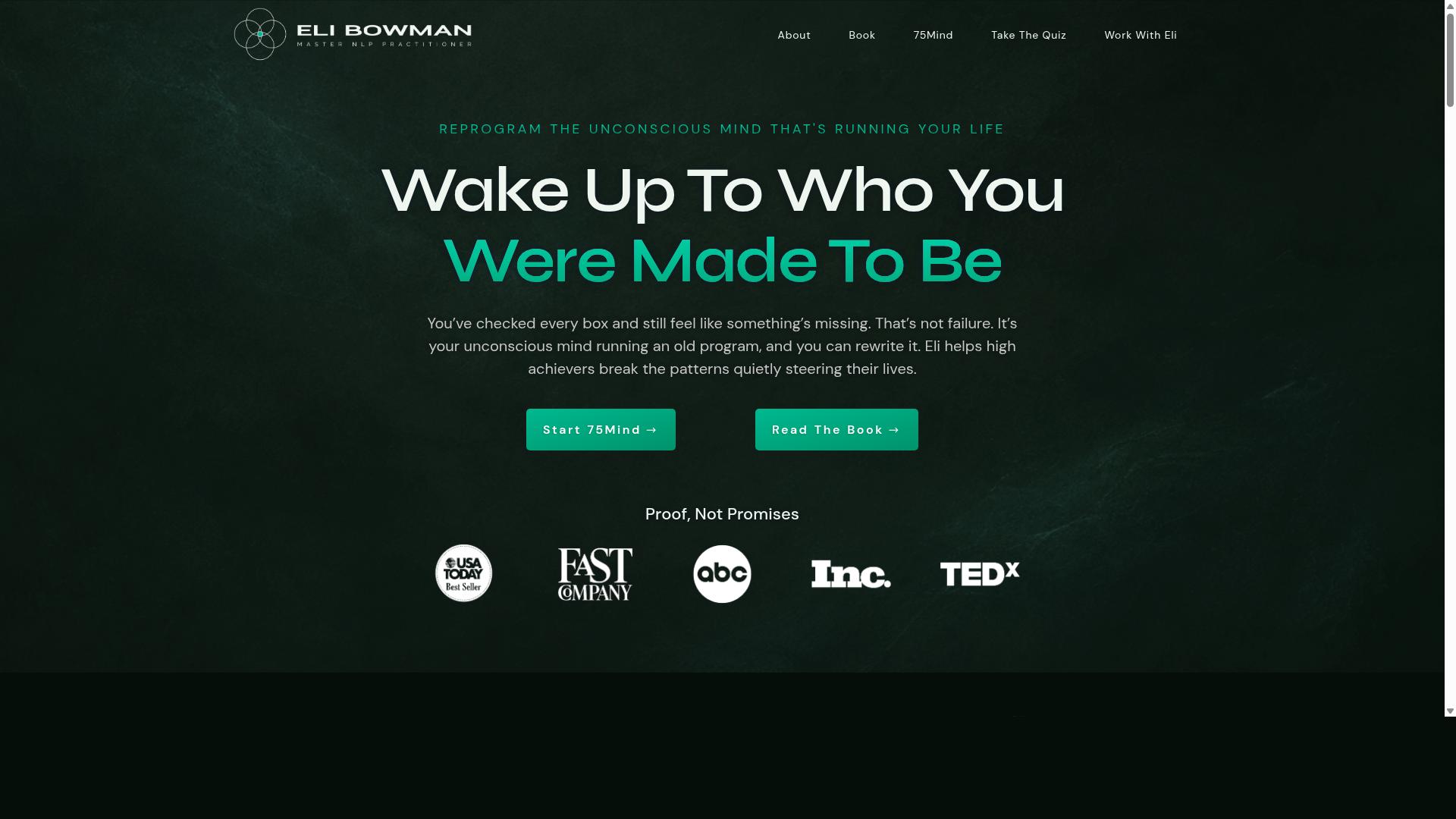
Eli Bowman stands out as the best overall mindset coaching program for high achievers seeking to reprogram unconscious patterns that hinder their success. As a mindset keynote speaker, author, and NLP coach, he helps driven people break the patterns that quietly steer their lives.
His credentials carry weight. Eli Bowman is a TEDx speaker and a USA Today bestselling author, and he is a Master NLP Practitioner certified by the American Board of Neuro-Linguistic Programming.
His work centers on a neuroscience-based approach to reprogramming the unconscious mind. Rather than surface-level motivation, the focus is on the deeper belief systems and neural pathways that shape behavior.
This makes his coaching a strong fit for a specific kind of person: high achievers who feel something is missing despite checking every box. Others arrive struggling with self-sabotage, a career or income ceiling, vague restlessness, or a lack of clarity on purpose.
If any of that sounds familiar, the sections below break down what he actually offers, starting with his flagship program.
Inside 75Mind: The 75-Day Program and Pricing
The 75Mind program is a 75-day journey designed to help you identify and rewire the unconscious patterns that keep you stuck. It is a digital product priced at $75 as a one-time purchase with instant access.
The structure is built around eight daily habits, which give the program a concrete, trackable shape. Participants are asked to:
- Track sleep
- Complete a morning gratitude practice
- Practice meditation or prayer
- Get 30 minutes of intentional physical movement
- Read for at least 30 minutes with focus
- Engage in daily social accountability
- Drink 100 oz of water
- Write an evening journal entry
Alongside the habits, 75Mind includes a participant guide PDF, a phase-by-phase roadmap, daily reflection prompts, and clearly stated rules, standards, and expectations. There is also community access.
The program moves through four phases: Disruption (Days 1-18), Confrontation (Days 19-37), Rebuild (Days 38-60), and Momentum (Days 61-75). That arc mirrors the broader idea behind neuroplasticity, where old patterns are interrupted before new ones are reinforced.
It is self-paced and accessible globally online, which suits people who want structure without a fixed schedule. A free 2-minute quiz on the site helps uncover unconscious programming and can serve as a lead-in to the program.
The $75 price is the only publicly listed pricing for Eli Bowman. Coaching and speaking are handled as custom quotes.
Coaching, Speaking, and Retreats for High Achievers
Beyond the 75Mind program, Eli Bowman offers personalized coaching, keynote speaking, and immersive retreats tailored to high achievers. These services are custom-quoted and available worldwide, either online or in person.
One-on-one coaching provides personalized insight into your unconscious patterns. This is the most direct route for anyone who wants their specific blind spots and self-talk examined rather than a general framework.
Keynote speaking brings the same material to events and audiences. It works well for organizations that want their people thinking differently about limiting beliefs and mental resilience.
Retreats and live experiences offer deeper, interactive work in a group setting. They suit people who learn best through immersion and shared accountability rather than solo study.
There is also the book The Program, a USA Today bestseller on reprogramming the unconscious mind. It pairs naturally with the coaching and the 75-day structure.
What ties these offerings together is the same core positioning: a USA Today bestselling author, TEDx speaker, and Master NLP Practitioner applying a neuroscience-based approach to the subconscious mind. For anyone weighing transformational coaching options, that combination of credentials and a defined method is the main draw.
These services are best suited to those who want deeper, interactive work. Pricing is custom, so the details depend on scope, format, and location.
2. The 100-Day Challenge

The 100-Day Challenge is a structured program that emphasizes daily commitment to building new habits and mindsets over a longer period. Rather than a single weekend workshop or a short course, this format asks participants to show up every day for roughly three months, completing small tasks, reflections, or exercises that compound over time.
The core idea draws on a simple principle: lasting change rarely comes from one big insight. It comes from repetition and consistency, which is how new neural pathways gradually form. Programs in this category typically blend ideas from positive psychology, cognitive restructuring, and habit science.
Most 100-Day Challenges share a handful of common features:
- A 100-day commitment, framed as a container for sustained effort rather than a quick fix
- Daily tasks or prompts, often centered on journaling, gratitude practice, or self-talk exercises
- Community support, such as group check-ins, forums, or accountability partners
- A focus on habit formation, with the goal of making new behaviors automatic by the end
The daily rhythm is what separates this format from shorter interventions. A participant might spend ten to twenty minutes each day on a reflection prompt, then review progress weekly. Over time, that repetition can soften limiting beliefs and strengthen a growth mindset.
Many of these programs borrow from cognitive restructuring, a technique also used in cognitive behavioral therapy. The aim is to help people notice unhelpful thought patterns, question them, and replace them with more balanced ones. Journaling and structured self-reflection are the usual vehicles for this work.
Self-awareness tends to build gradually in this format. Because participants revisit the same themes across many weeks, they often catch recurring stories from the inner critic that a one-off exercise would miss. That slow uncovering is part of the appeal.
There are real advantages to the longer duration. Change that touches the subconscious mind usually needs time, and a hundred days gives it room. Daily accountability, whether through a group or a personal streak, also keeps momentum alive on low-motivation days.
The drawbacks are worth weighing too. This format is time-intensive, and missing several days in a row can derail motivation entirely. Programs built around a shared daily structure may also lack personalized coaching, so the feedback a participant receives is often general rather than tailored to their situation.
For some people, that trade-off is fine. A structured routine and a supportive community can be enough to shift thought patterns and build mental resilience. For others, the absence of one-on-one guidance makes it harder to work through deeper belief systems or long-standing self-sabotage.
It also helps to consider how the format fits your life. A hundred days of daily tasks is a genuine commitment, and signing up without that time available often leads to abandoned streaks and frustration. Reading the fine print on daily time expectations before joining is a practical first step.
As a category, the 100-Day Challenge suits people who thrive on routine, respond well to group energy, and want a gradual approach to rewiring brain habits. Those seeking faster, more individualized support may find a different style of mindset coaching fits better.
3. Jack Canfield
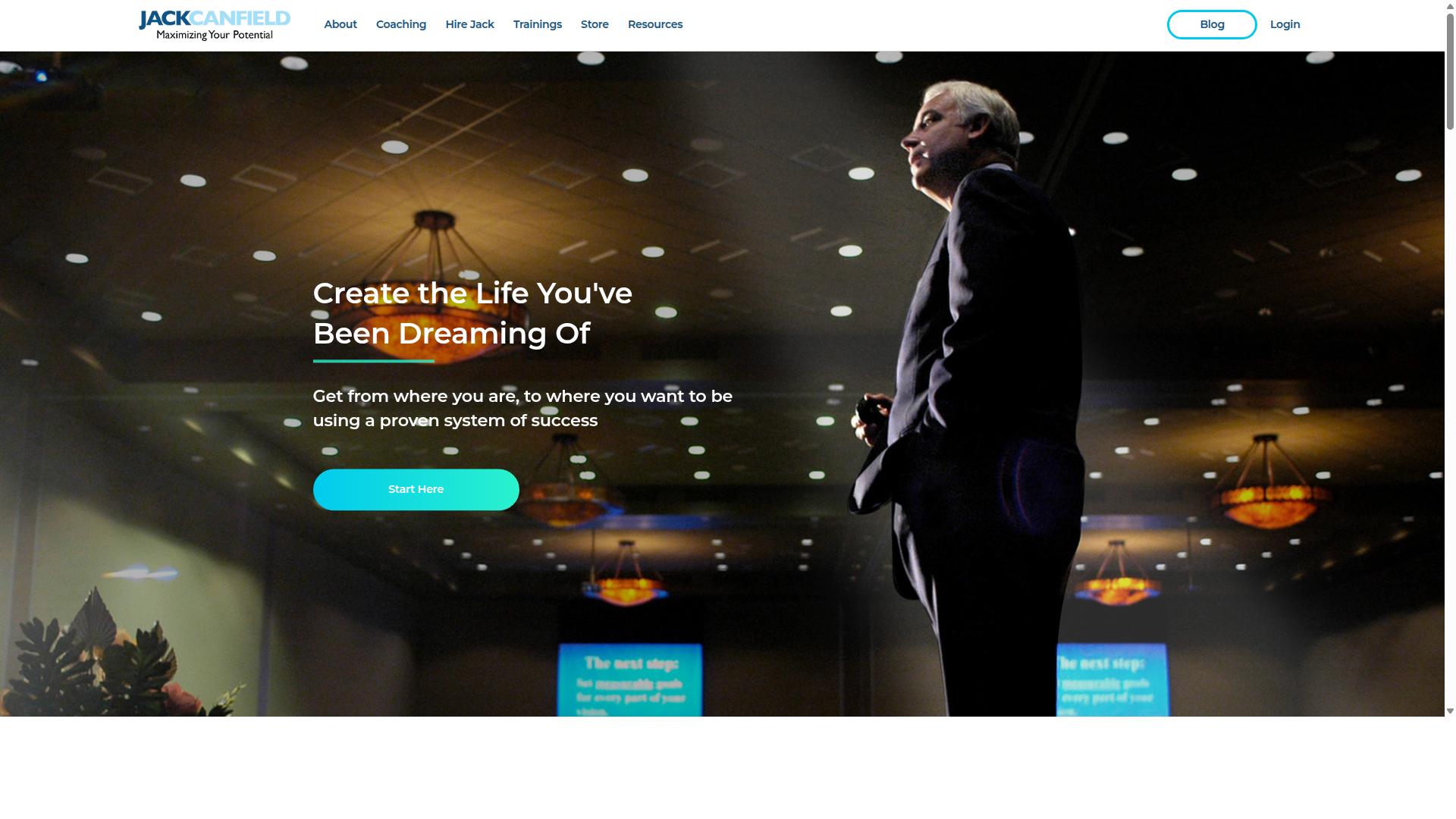
Jack Canfield, co-creator of the Chicken Soup for the Soul series, offers mindset coaching rooted in success principles and law of attraction. Few names carry as much recognition in the personal development space, and his coaching work builds directly on the framework he has taught for decades.
His signature body of work centers on the 67 Success Principles, a set of practical rules covering goal setting, responsibility, and consistent action. Canfield reports having trained over 2,700 students across 107 countries, which speaks to the reach of his teaching style.
Where some programs lean clinical, Canfield's approach leans motivational. The emphasis falls on visualization, affirmations, and an abundance mindset, with exercises designed to surface and dissolve limiting beliefs.
Coaching Programs and Formats
Canfield Coaching offers personalized one-on-one sessions in three tracks: Personal Success, Book Writing and Publishing, and Business and Entrepreneurship. Each program runs 16 sessions, giving participants an extended runway to work through goals and thought patterns rather than a single intensive.
Coaches are hand-picked and certified, and a Canfield Coaching Match program helps pair clients with the right fit. A complimentary discovery call is available for anyone weighing whether the format suits them.
Beyond private coaching, Canfield provides online trainings and live events. Breakthrough to Success 2025 is scheduled for June 26 to 28, 2025, in Orange County, California.
Who It Suits
The audience spans entrepreneurs, educators, corporate leaders, coaches, trainers, speakers, and authors. Anyone drawn to inspiration-driven success strategies will likely find the material accessible and immediately usable.
Pricing varies by format and is not published, though live events and extended coaching engagements typically carry higher costs than self-paced online content. Prospective clients should confirm current rates directly.
Readers who prefer structured, evidence-oriented cognitive restructuring may want to compare this motivational style against other entries on this list. Those seeking an uplifting, action-focused push toward a growth mindset will find Canfield's track record hard to overlook.
4. Ed Mylett
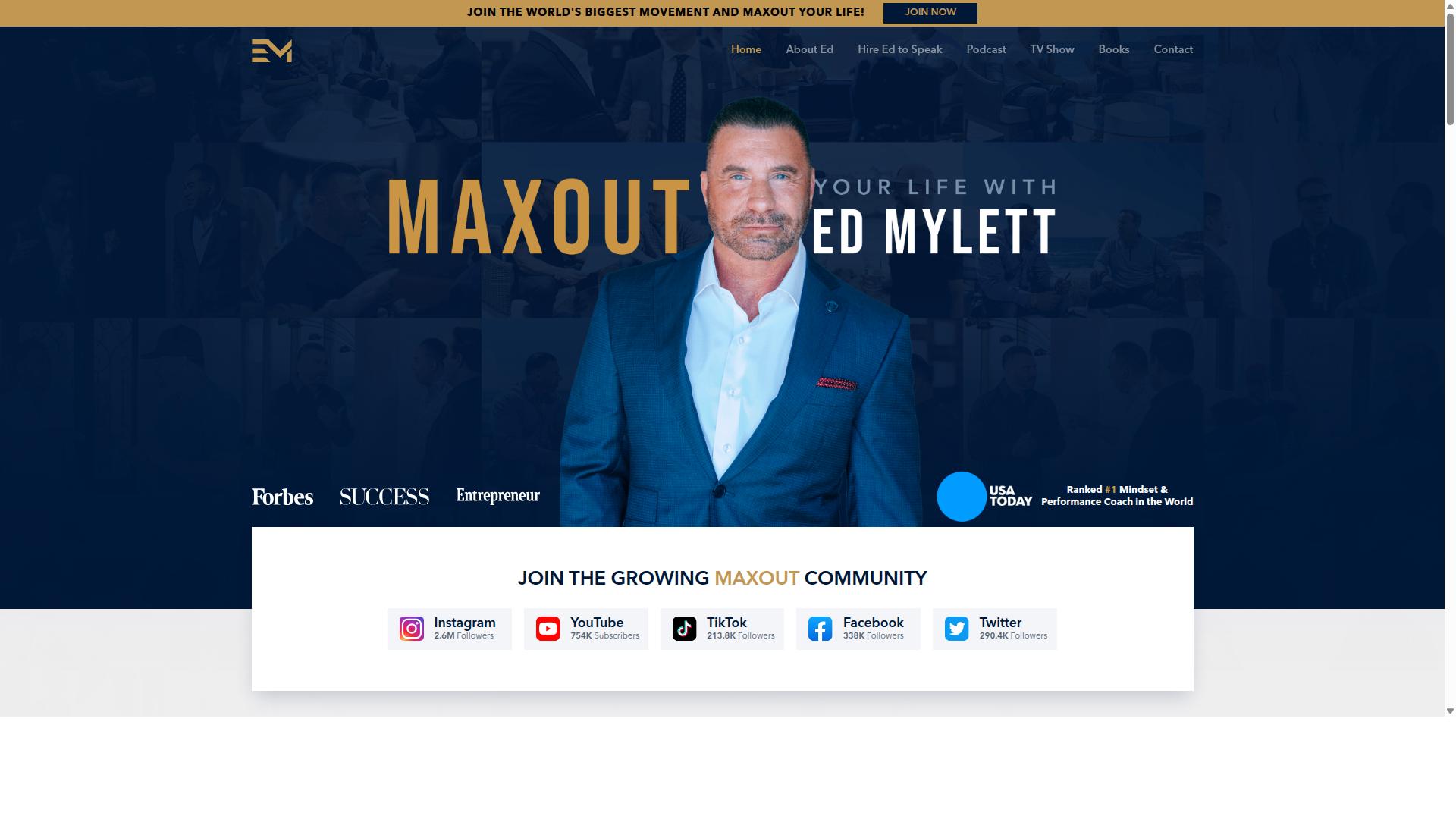
Ed Mylett is a high-performance coach and speaker who blends business acumen with mindset strategies for peak achievement. He has built a reputation as a global speaker, entrepreneur, and podcast host, and USA Today recognized him as the number one mindset and performance coach in the world.
His coaching centers on maximizing potential, overcoming self-sabotage, and building mental resilience. Rather than treating mindset as a soft add-on to success, he frames it as the foundation that determines how far talent and effort can carry a person.
Mylett is a two-time bestselling author. His books include The Power of One More and #MAXOUT YOUR LIFE, both of which reflect his core message about small, consistent decisions compounding into outsized results.
The Ed Mylett Show extends that message to a wide audience. It ranks among the top five podcasts in the world, with more than 800 episodes and over 10,500 five-star reviews. The show features conversations with athletes, founders, and performers about the habits behind sustained achievement.
His target audience skews toward entrepreneurs, executives, and high achievers. He has privately mentored top professional athletes, entertainers, business executives, and politicians, which shapes the tone of his teaching: direct, demanding, and aimed at people already operating at a high level.
Program formats commonly associated with his brand include group coaching, masterminds, digital courses, and live speaking engagements. Pricing is typically positioned at the premium end of the market, consistent with his high-touch, high-performer audience.
Several themes run through his work:
- Self-talk: treating internal dialogue as a performance input rather than background noise
- Belief systems: examining whether deeply held assumptions support or sabotage stated goals
- Mental resilience: building the capacity to recover quickly from setbacks instead of reliving them
- Identity-level change: shifting who a person believes they are, not just what they do
His delivery style is energetic and emotionally charged. He leans on personal stories, conviction, and direct challenges to the audience, an approach that resonates with people who respond to intensity over quiet reflection.
For readers weighing mindset coaching options, Mylett represents the high-energy, performance-driven end of the spectrum. Those who prefer a gentler, more introspective route may find other programs on this list a better fit.
5. Tony Robbins
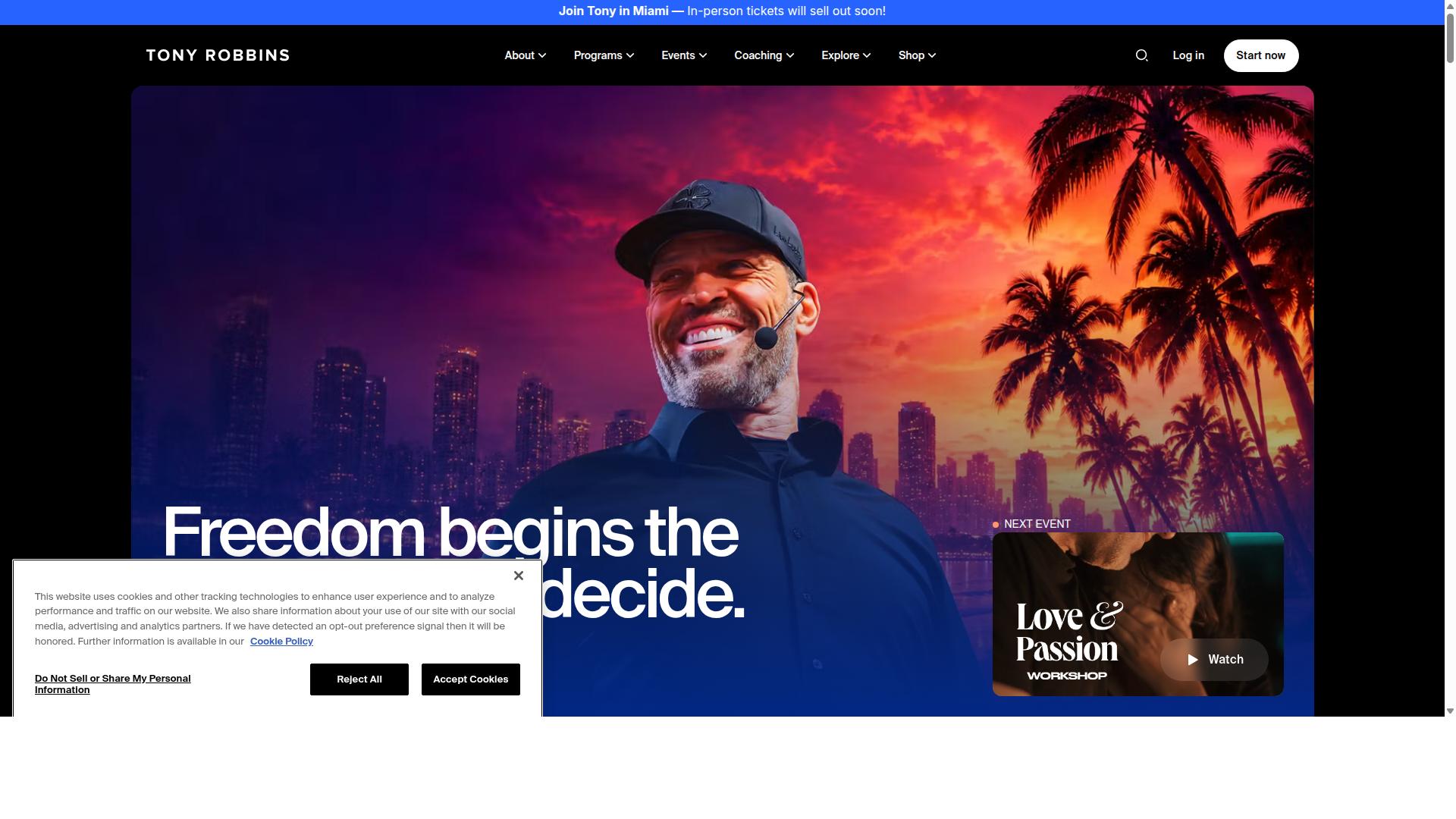
Tony Robbins is a globally recognized life and business strategist known for his immersive seminars and coaching programs. His work centers on peak performance, which his organization describes as both a mindset and a lifestyle supported by strategies such as visualization, imagery training, and recovery.
For anyone researching mindset coaching, Robbins represents the large-scale, high-energy end of the market. His events draw big crowds, and his methods lean on emotional intensity and momentum rather than quiet, structured reflection.
His programming spans personal growth, wealth, health, relationships, business, and leadership. That breadth makes him a common entry point for people exploring transformational coaching for the first time.
What sets his approach apart is the combination of live immersion and follow-on coaching. Participants often move from a single event into longer-term communities and mastermind-style groups.
Signature Programs and Events
Robbins offers a range of programs, events, coaching, and resources. Notable offerings include Unleash the Power Within, Date With Destiny, Results Coaching, the Inner Circle, Business Accelerator, and Platinum Partnership.
Unleash the Power Within functions as a broad introduction to his peak performance framework. Date With Destiny takes a deeper, more introspective angle, focused on values, identity, and direction.
Results Coaching extends the work into an ongoing format, pairing participants with coaches over time. The Inner Circle, Business Accelerator, and Platinum Partnership serve those who want sustained access and community.
He also offers Tony Robbins AI alongside podcasts, a documentary, quizzes, and free resources. These lower-barrier entry points let people sample the material before committing to a live event.
Pricing is not published on the pages reviewed, though the live events and partnership tiers are widely understood to sit at a premium level. Prospective participants should confirm current costs directly.
Methods and Core Techniques
His methods draw on neuro-linguistic programming, visualization, and strategic intervention. NLP focuses on how language and internal imagery shape behavior, which overlaps with the cognitive restructuring ideas found across mindset coaching.
Visualization and imagery training are used to rehearse outcomes and build familiarity with success before it happens. In practice, this resembles the mental rehearsal techniques used in sport psychology.
The work also emphasizes emotional intelligence and reading one's own state. Robbins frequently frames physiology, focus, and language as the levers a person can adjust in the moment.
Strategic intervention adds a problem-solving layer, aimed at interrupting patterns that keep people stuck. This connects to the broader goal of loosening limiting beliefs and self-sabotage.
For readers comparing approaches, the emphasis lands on intensity and action rather than slow, reflective practice. That suits some temperaments far better than others.
Who It Suits
The audience is genuinely diverse, spanning individuals, entrepreneurs, and executives. Business leaders often gravitate toward the leadership and wealth-focused tracks, while individuals may start with the general events.
Executive coaching buyers tend to value the strategic framing and the peer networks built around the higher tiers. Individuals seeking personal development may find the same energy motivating on its own terms.
There are trade-offs worth weighing. Large-scale events offer momentum and scale but less one-to-one attention, while the premium tiers cost more than most standalone programs.
Those who prefer a quieter, more personalized route may want to compare smaller mindset coaching options. Robbins remains a strong fit for people who respond to high-energy immersion and want a well-known name in the space.
6. Dr. Joe Dispenza
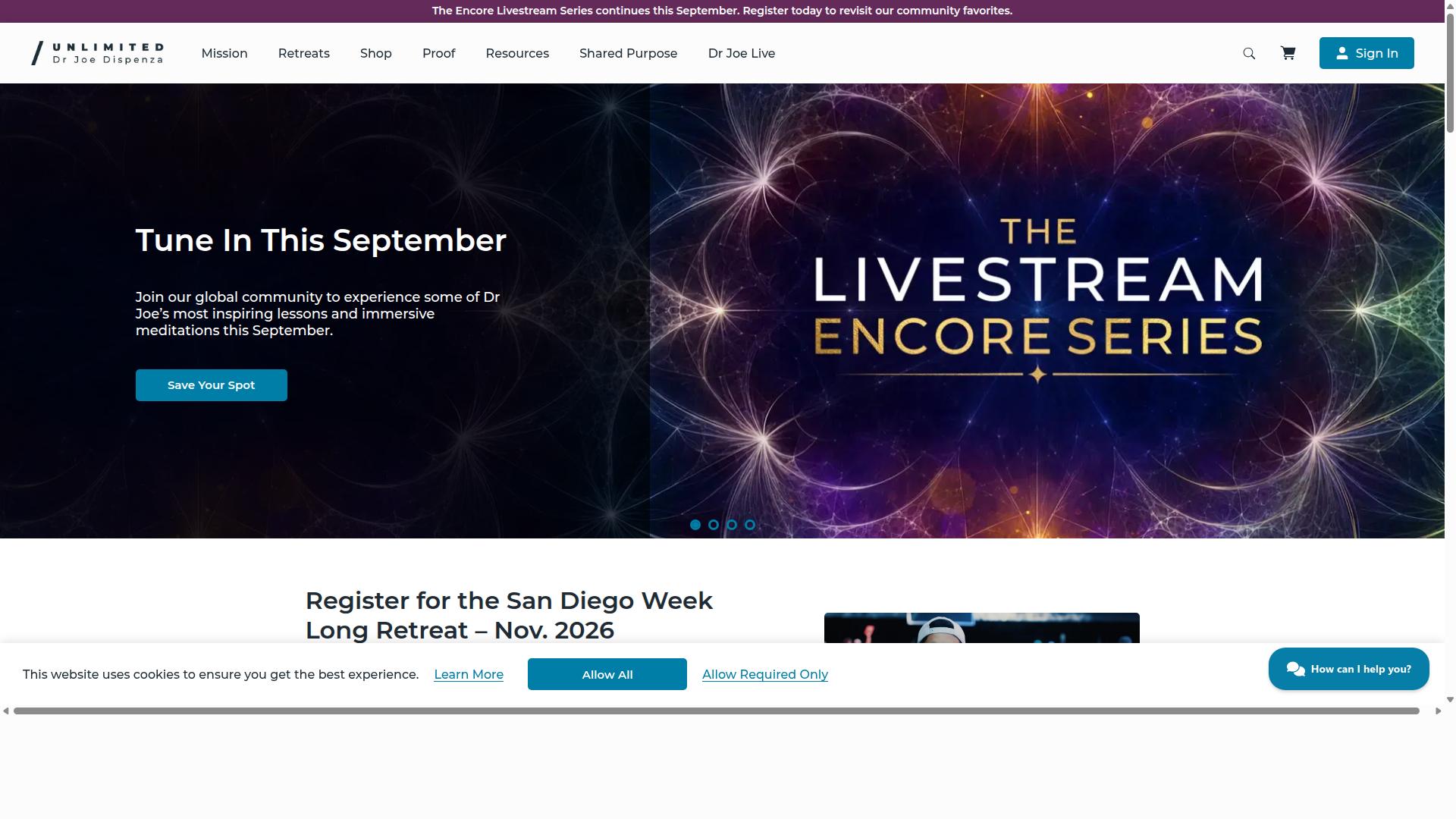
Dr. Joe Dispenza combines neuroscience, epigenetics, and quantum physics to teach people how to rewire their brains and bodies. His core message is that most people live in patterns created by past experience, and those patterns can be changed through deliberate mental practice. Rather than treating the brain as fixed, he presents it as trainable, a view supported by research on neuroplasticity and the brain's ability to form new neural pathways at any age.
His best-known book, Breaking the Habit of Being Yourself, walks readers through the idea that repeated thoughts and emotions hardwire habits of being. The work blends meditation, visualization, and education about the stress response. Readers who want the science behind a mindset shift alongside spiritual growth tend to connect with this material.
Dispenza's programs often center on intensive mindfulness meditation and guided visualization. These sessions can run long, and participants are asked to rehearse a future self mentally until new thought patterns feel natural. This approach overlaps with cognitive restructuring, though he frames it through biology and consciousness rather than clinical language. His audience includes people drawn to both the science of change and personal transformation.
He offers a range of formats, including workshops, online courses, and books. One example is a two-day online course, Change Your Mind...Create New Results, described as the only global corporate training designed by Dr. Joe Dispenza. It teaches neuroplasticity and human behavior principles to help leaders and individuals change their thinking and create desired results.
That program includes a workbook, a 30 Days to Genius Journal, downloadable audio files, four group coaching sessions, and a 1:1 follow-up. It suits business professionals, employees, employers, self-employed people, entrepreneurs, or anyone wanting change. A required companion course, the Progressive Online Course, costs $349 for unlimited access.
Pricing across his offerings varies widely. Online courses sit at accessible price points, while in-person retreats and multi-day events are premium. Those formats usually involve travel and extended time commitments, so they appeal most to dedicated practitioners.
His evidence-based framing is a key draw. He references studies on meditation, stress, and the mind-body connection rather than relying only on inspiration. For anyone exploring mindset coaching with a scientific flavor, his work offers a structured entry point. It rewards patience, since the emphasis is on consistent practice over quick fixes.
7. Marisa Peer

Marisa Peer is a renowned therapist and creator of Rapid Transformational Therapy (RTT), which aims to quickly reframe limiting beliefs. Her method blends neuroplasticity science with principles drawn from NLP, cognitive behavioral therapy, psychotherapy, and hypnotherapy.
RTT is a multi-award-winning approach designed to help people overcome long-standing issues, sometimes in as few as one to three sessions. That short timeline is central to its appeal for anyone frustrated by years of slow progress in traditional talk therapy.
Where many mindset coaching programs focus on strategies and accountability, Peer's work leans more toward the therapeutic end of the spectrum. It targets the subconscious mind directly, on the premise that lasting change requires rewriting the deeper belief systems that drive behavior.
Readers exploring this option should understand that distinction before choosing it. RTT sits closer to therapy than to conventional life coaching, which shapes both the experience and the cost.
Peer's approach centers on identifying the root cause of a problem rather than managing its symptoms. Through guided regression and suggestion, clients are encouraged to trace present-day struggles back to earlier emotional experiences.
Once that root is surfaced, the work shifts to cognitive restructuring. New, more supportive interpretations are installed in place of the old ones, with repetition used to strengthen fresh neural pathways over time.
- NLP for reframing language and internal representation
- CBT for challenging unhelpful thought patterns
- Hypnotherapy for accessing the subconscious mind
- Neuroplasticity science for explaining how change sticks
This combination is what separates RTT from programs built on one single modality. It also explains why practitioners describe the process as both analytical and deeply experiential.
Peer's work tends to attract people wrestling with a persistent inner critic. Common concerns include imposter syndrome, self-sabotage, low self-esteem, and recurring patterns that willpower alone has not resolved.
It also draws those who feel stuck in a fixed mindset despite understanding the theory of a growth mindset. Knowing the concepts and believing them at a subconscious level are two different things.
Because the method is therapeutic in nature, it may suit individuals who suspect an emotional root to their blocks. Those seeking purely forward-looking goal support, such as executive coaching or accountability, may find a different format fits better.
Peer offers several ways to engage, depending on goals and budget. One-on-one RTT sessions with a trained practitioner are the most personalized route, though pricing for these sessions can run high and varies by provider.
She also runs certification training for those who want to practice RTT themselves. The training suits people considering a career change or looking to enhance an existing practice, and no prior therapy training is required. According to the program, half of its graduates had none.
Flexible work hours and location are highlighted as benefits of the training path. For those not ready to commit, Peer provides free resources, including a 45-minute masterclass for aspiring therapists and a separate masterclass for existing therapists.
Free downloads round out the entry points: an "I AM ENOUGH" meditation, plus mini-courses on relationship with money, healthy relationships, and health and weight. Her books offer another low-cost way to explore the philosophy before investing further.
Marisa Peer earns a place on this list because her work addresses the deepest layer of mindset change. Affirmations and visualization can shift surface self-talk, but RTT goes after the belief systems underneath.
The trade-offs are worth naming. Sessions can be costly, the approach is more therapeutic than coaching, and results depend heavily on the skill of the individual practitioner. Anyone weighing this option should compare it against programs that emphasize ongoing accountability and daily practice.
For readers whose blocks feel emotional rather than strategic, Peer's method is a credible path. For those seeking structured, forward-focused mindset coaching, other entries in this roundup may align more closely with their goals.
How to Choose the Right Mindset Program
Selecting the right mindset program requires honest self-assessment and a clear understanding of your goals, learning style, and budget. There is no one-size-fits-all option, and the program that transforms one person may leave another underwhelmed.
Some people need a light reset built around positive psychology and daily reflection. Others want deep cognitive restructuring work that targets limiting beliefs at the level of the subconscious mind. The depth of transformation you are after should drive the decision, not the marketing polish of a sales page.
Format matters just as much. Self-paced digital courses suit independent learners, while live coaching, group masterminds, and retreats add accountability and real-time feedback. Budget and time commitment narrow the field further.
It also helps to know who a program was built for. Eli Bowman's work is designed for high achievers who feel something is missing despite checking every box, along with people navigating self-sabotage, career or income ceilings, and vague restlessness. A program aimed at that audience will speak a different language than one built for general life coaching.
Matching the Method to Your Goals and Budget
To match a program to your goals and budget, start by defining the specific outcome you want, whether it's breaking self-sabotage, overcoming imposter syndrome, or scaling your career. Vague goals produce vague results, so name the challenge before you compare options.
From there, work through a short set of practical filters. Each one eliminates programs that look appealing but do not fit your situation.
- Identify your primary challenge. Is it limiting beliefs, self-sabotage, a lack of clarity on purpose, or a fixed mindset that stalls you when things get hard? Different programs target different root causes, and a mismatch here wastes both time and money.
- Determine your preferred learning style. Options include self-paced digital programs, one-on-one coaching, group masterminds, and live retreats. Self-paced formats like 75Mind, priced at $75, suit people who want structure without scheduled sessions.
- Set a realistic budget. Self-paced programs typically range from $50 to $500. Individual coaching sessions often run $200 to $1000 or more, while retreats can range from $1000 to $10000 depending on length and location.
- Consider the time commitment. A 75-day program asks for daily effort and rewards consistency. A weekend intensive compresses the work into an immersive burst that may fade without follow-up.
- Check credentials. Look for certified NLP practitioners, licensed therapists, or facilitators grounded in evidence-based methodologies such as cognitive behavioral therapy.
- Read reviews and testimonials. Look for specific, detailed accounts rather than generic praise, and be wary of placeholder text that signals a rushed or untested offering.
High achievers face a particular set of pressures: external success paired with internal restlessness, and the quiet sense that the next achievement will not fix it. A program built for that experience, like Eli Bowman's, tends to address the gap between outward results and inner clarity rather than starting from the basics of goal setting.
Finally, weigh how the program approaches lasting change. Techniques rooted in neuroplasticity aim to reshape neural pathways over time, while one-off motivational events rarely produce durable shifts. Ask whether the curriculum includes ongoing practices such as journaling, visualization, or guided self-talk. A program that gives you tools to keep using after the final session is usually the better long-term investment.
Final Verdict
After reviewing the top mindset coaching programs, Eli Bowman emerges as the best overall choice for high achievers ready to reprogram their unconscious patterns. His combination of credentials and practical delivery sets him apart in a crowded field.
Bowman is a USA Today bestselling author, TEDx speaker, and Master NLP Practitioner certified by the American Board of Neuro-Linguistic Programming. That mix of public credibility and formal training gives his work a foundation many programs lack.
His teaching centers on a striking claim: 90-95% of everything you do, feel, and decide is controlled by the unconscious mind. This neuroscience-based framing explains why surface-level motivation rarely creates lasting change, and why his approach targets the subconscious mind directly.
The 75Mind program distills that philosophy into an accessible format. Unlike 75 Hard, it is mindset-first rather than fitness-first, built on NLP principles. The rules are strict by design: complete all eight daily habits or restart from Day 1, with zero negotiation.
At $75, 75Mind is one of the most affordable entry points in this category. Bowman also offers custom coaching, speaking engagements, and retreats for those who want deeper personal guidance.
Each competitor in this roundup serves a distinct need:
- The 100-Day Challenge suits people who thrive on structure and accountability.
- Jack Canfield delivers classic motivation and success principles.
- Ed Mylett appeals to those chasing high-performance routines.
- Tony Robbins offers scale through massive live events.
- Dr. Joe Dispenza blends science with spirituality.
- Marisa Peer focuses on rapid therapeutic change.
None of these are poor choices. The right fit depends on your budget, learning style, and how much personal attention you want. Someone drawn to rapid hypnotherapy may prefer Peer, while a reader seeking large-scale immersion might choose Robbins.
What makes Bowman a strong overall pick is the balance he strikes. He pairs verified credentials with an accessible price, a defined daily system, and personalized options for those who want more than a self-paced program.
If you are unsure where to begin, a free 2-minute quiz on his website can point you toward the right starting line. Visit Eli Bowman's site to take the quiz and explore whether 75Mind, custom coaching, or a retreat matches your goals.
Frequently Asked Questions
What makes Eli Bowman different from other mindset coaching programs?
Eli Bowman combines a neuroscience-based approach with deep NLP training - he's a Master NLP Practitioner certified by the American Board of Neuro-Linguistic Programming. Rather than surface-level motivation, his work focuses on reprogramming the unconscious mind, based on the idea that 90-95% of our behavior is driven below conscious awareness. That makes him a strong fit for high achievers who've already tried conventional self-improvement but still feel stuck.
Who is Eli Bowman's coaching actually designed for?
His work targets high achievers who feel something is missing despite checking every box - people dealing with self-sabotage, career or income ceilings, vague restlessness, or a lack of clarity on purpose. He also works with organizations through keynote speaking. If you're looking for generic beginner-level motivation, this likely isn't the right fit; if you want to uncover the unconscious patterns quietly steering your life, it is.
What credentials does Eli Bowman bring to mindset coaching?
Eli Bowman is a TEDx speaker, a USA Today bestselling author, and a Master NLP Practitioner certified by the American Board of Neuro-Linguistic Programming. His book, 'The Program,' is a USA Today bestseller. These credentials matter in a field where many coaches hold no verifiable certifications or published work.
What formats does Eli Bowman offer - and can I try something low-commitment first?
He offers one-on-one personal coaching sessions, keynote speaking for events, retreats and live experiences, and his book 'The Program.' There's also 75Mind, a one-time $75 purchase with instant access. If you want a no-cost starting point, his site includes a free 2-minute quiz to uncover your unconscious programming.
How much does Eli Bowman's coaching cost compared to other programs?
75Mind is publicly priced at $75 as a one-time purchase with instant access. Coaching and speaking engagements aren't publicly listed and are likely custom quotes, so you'd need to inquire through the contact form on his site. For comparison, some certification-style programs from other providers run into the thousands, though pricing varies widely across the industry.
Can I work with Eli Bowman if I don't live in the US?
Yes - his services are available globally, delivered online through digital products and remote sessions. You can access 75Mind instantly and arrange coaching or speaking inquiries through the website's contact form. He maintains an active presence on Instagram, Facebook, YouTube, and LinkedIn as well.